
Impact of Education Technology on Rural Learning Outcomes in the Democratic Republic of the Congo
- Mar 20
- 6 min read
Updated: Apr 29
A Story Rooted in Experience
Long before VillageInvest Africa took shape on paper, its mission was formed through lived experience in the Democratic Republic of the Congo. I remember early mornings in my village - the red earth cool beneath my feet - as my siblings and I walked toward a modest cinderblock classroom. Desks were scarce, chalk broke easily, and when the rains came, learning often paused altogether.
Ours was an education built on improvisation. Yet even then, one truth stood out clearly: the desire to learn far exceeded the systems designed to support it. What was missing was not motivation - it was infrastructure, access, and continuity.
Today, through visits across rural communities in the DRC, members of VillageInvest Africa (VIA) continue to encounter that same reality. The environments may differ slightly, but the underlying story remains consistent: strong ambition constrained by fragile systems.

Mapping the Divide: Rural Education Challenges in DR Congo
During visits to rural regions across the DRC, VIA’s team observed recurring patterns that define the educational landscape.
In many communities, classrooms are overcrowded, with one teacher responsible for dozens of students. Teaching materials are limited, often outdated, and in some cases entirely absent. Teachers frequently rely on memory and improvisation to deliver lessons.
Children walk long distances - sometimes over ten kilometres - to attend school. During the rainy season, these journeys become unsafe or impossible, leading to extended interruptions in learning.

Infrastructure challenges are deeply embedded:
Schools without reliable electricity
Limited or no access to internet connectivity
Buildings vulnerable to weather conditions
Inconsistent access to water and sanitation
Where urban schools continue to advance, rural learners risk falling further behind - not due to lack of effort, but due to structural barriers beyond their control.
The Value of Lived Insight
At VillageInvest Africa, understanding these challenges does not come from reports alone. It comes from direct engagement.
Through time spent in classrooms, conversations with teachers, and interactions with families, VIA’s team has gained insight into the everyday decisions and constraints shaping education in rural communities.

These experiences reveal a consistent pattern:
External solutions often overlook local realities
Technology introduced without context fails to sustain
Short-term interventions rarely create lasting change
What emerges instead is a clear need for solutions that are not only innovative, but grounded in the lived experiences of the communities they aim to serve.
EdTech in Context: Opportunities Observed in DRC
Each challenge encountered across rural communities also reveals a corresponding opportunity - if approached thoughtfully.
Offline-First Learning: Bridging the Connectivity Gap
In environments where internet access is unreliable or non-existent, any effective educational technology must function offline.

Teachers expressed strong interest in:
Preloaded digital content aligned with national curricula
Tools that allow lessons to be repeated and reinforced
Resources that support both students and under-trained educators
The opportunity lies not in high-bandwidth platforms, but in accessible, resilient learning systems that operate independently of connectivity.
Solar-Powered Devices: Energy as an Enabler
Across many of the communities visited, electricity remains inconsistent. Yet one resource is consistently available: sunlight.
This creates a practical foundation for:
Solar-powered charging systems
Low-energy learning devices such as tablets or eReaders
Shared classroom access models

Community members have shown openness to such solutions - particularly when they are durable, easy to maintain, and clearly beneficial to students.
Radio and Mobile Learning: Leveraging Existing Tools
Radio continues to play a central role in communication across rural DRC. This presents a powerful opportunity for:
Curriculum-aligned educational broadcasts
Supplementary learning through audio content
Community-based listening groups
In addition, the widespread use of basic mobile phones enables:
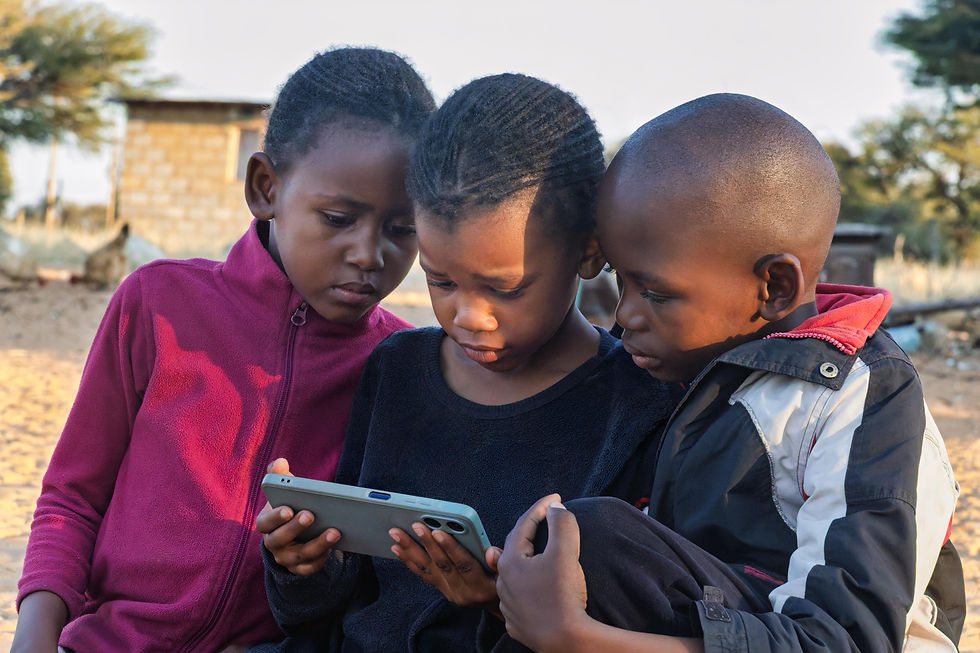
SMS-based learning support
Audio lessons accessible without internet
Simple communication between educators and families
These tools are already embedded in daily life—making them highly adaptable for educational use.
Personalised Learning Through Simple Technologies
While advanced digital systems may not yet be feasible in many rural areas, simplified forms of personalised learning show strong potential.
Teachers highlighted the need for:
Basic progress tracking tools
Structured feedback for students
Support for foundational numeracy and literacy
Lightweight, SMS-based or offline systems could begin to address these needs without requiring significant infrastructure investment.
Collaboration at the Core: A Partnership-First Approach
One of the clearest lessons from VIA’s field exposure is that technology alone does not drive change - people do.
In every community visited, effective solutions depend on:
Teachers shaping how tools are used
Community leaders guiding implementation
Parents supporting and sustaining initiatives
Local context informing every design decision

Many past initiatives have struggled because they prioritised distribution over engagement.
VIA’s approach is different: start with relationships, build trust, and co-create solutions that communities can own.
Understanding Impact Before Implementation
Although VIA has not yet launched full-scale pilot programs, early engagement has revealed strong indicators of potential impact.
Across multiple communities:
Students show high enthusiasm for interactive learning tools
Teachers express willingness to adopt new methods when supported
Parents value education and are eager to see tangible improvements
Communities are open to innovation when it aligns with their realities

These signals suggest that with the right approach, education technology can significantly improve learning outcomes.
However, they also reinforce the importance of careful design and measured implementation.
From Insight to Action: The Road Ahead
The next phase for VillageInvest Africa is to transition from observation to carefully structured implementation.
Key priorities include:
Designing pilot programs rooted in specific community needs
Testing offline-first and low-cost solutions
Building long-term partnerships with educators and local stakeholders
Establishing clear frameworks for measuring impact
Rather than scaling prematurely, the focus will be on developing models that are both effective and sustainable.
Scaling with Integrity
Expanding impact across the DRC will require more than replication—it will require adaptation.
Each community presents unique challenges, shaped by geography, language, culture, and infrastructure. Successful solutions must remain flexible enough to respond to these differences.
By prioritising:
Local-language content
Community ownership
Continuous feedback and iteration
VIA aims to build systems that can grow without losing relevance.
A Collective Responsibility
Transforming rural education in the Democratic Republic of the Congo is not the responsibility of one organisation alone.
It requires collaboration across:
Educators
Communities
Policymakers
Investors and partners
For those looking to contribute, the opportunity is not to impose solutions, but to help build them - grounded in real-world insight and shared commitment.
Conclusion: Reframing What Is Possible
The challenges facing rural education in the DRC are complex, but they are not insurmountable.
Through lived experience, field engagement, and careful observation, VillageInvest Africa has gained a clear understanding of both the barriers and the opportunities.
The path forward is not about introducing technology for its own sake. It is about:
Designing with intention
Building with communities
Sustaining impact over time
Because when solutions reflect the realities of those they serve, education becomes not just accessible - but transformative.
VillageInvest Africa’s hallmark is partnership grounded in context - not formulas.
Because many of us have walked those same muddy paths and experienced unreliable infrastructure first hand, we understand that meaningful change begins with listening. Sustainable impact is not delivered; it is built - step by step - with the people it is meant to serve. Our approach centres on shared ownership, where ideas are shaped collaboratively and evolve through real-world insight.
By bringing together capital, local knowledge, and cross-sector collaboration, VIA aims to create the conditions for solutions that are practical, adaptable, and built to last. For partners and investors seeking genuine, measurable impact, this is not about short-term intervention - it is about laying the groundwork for long-term resilience and self-sufficiency.
Local educators and families are central to this process. They are not recipients of change, but co-creators of it. As VIA develops its initiatives, decisions are guided by lived realities -how students learn, how teachers teach, and what communities need to sustain progress over time. Partnerships with NGOs, policymakers, and social finance actors are designed to strengthen this ecosystem, ensuring that future solutions are rooted in trust, not just technology.
Collaboration across geographies strengthens this vision. Whether contributing technical expertise from Manchester, engaging in field-based learning in the Democratic Republic of the Congo, or supporting from afar, each contribution plays a role in shaping more inclusive and effective education systems.
Get involved:
Engage with VIA as it develops community-informed EdTech initiatives
Start partnership conversations or explore pilot opportunities
Subscribe for updates and insights from ongoing field engagement
Contribute expertise, mentorship, or funding toward early-stage innovation
No single organisation can deliver lasting educational transformation. Progress depends on shared effort - grounded in trust, driven by collaboration, and sustained over time.
VillageInvest Africa is building alongside communities, not ahead of them.

Comments